Capital equipment procurement carries immense stakes for manufacturing facility managers. Sourcing machinery overseas demands a careful, calculated balance. You must weigh upfront cost savings against severe long-term risks like unexpected downtime and integration failures. China dominates the global export market for plastic pipe manufacturing equipment today. You will find massive industrial hubs producing thousands of units annually. However, supplier capabilities vary wildly across these manufacturing zones. They range from basic equipment assemblers to tier-one automation engineers who build complex, highly synchronized systems. This guide breaks down the top manufacturers based on verifiable, objective criteria. We rigorously evaluate strict industry certifications, real-world integration capabilities, and global after-sales support networks. Read on to discover actionable frameworks to properly evaluate these vendors. You will learn how to confidently shortlist the right china belling machine supplier for your facility.
Key Takeaways
Supplier Stratification: The top 5 manufacturers are categorized by their specific strengths—from high-speed automation to cost-effective ODM customization.
Integration is Critical: A standalone machine is useless if it bottlenecks your existing PVC pipe production line. Synchronization capabilities separate tier-one suppliers from tier-two.
Evaluation Baseline: Avoid suppliers who cannot provide a transparent Factory Acceptance Test (FAT) framework and standardized (e.g., Siemens, PLC) global spare parts.
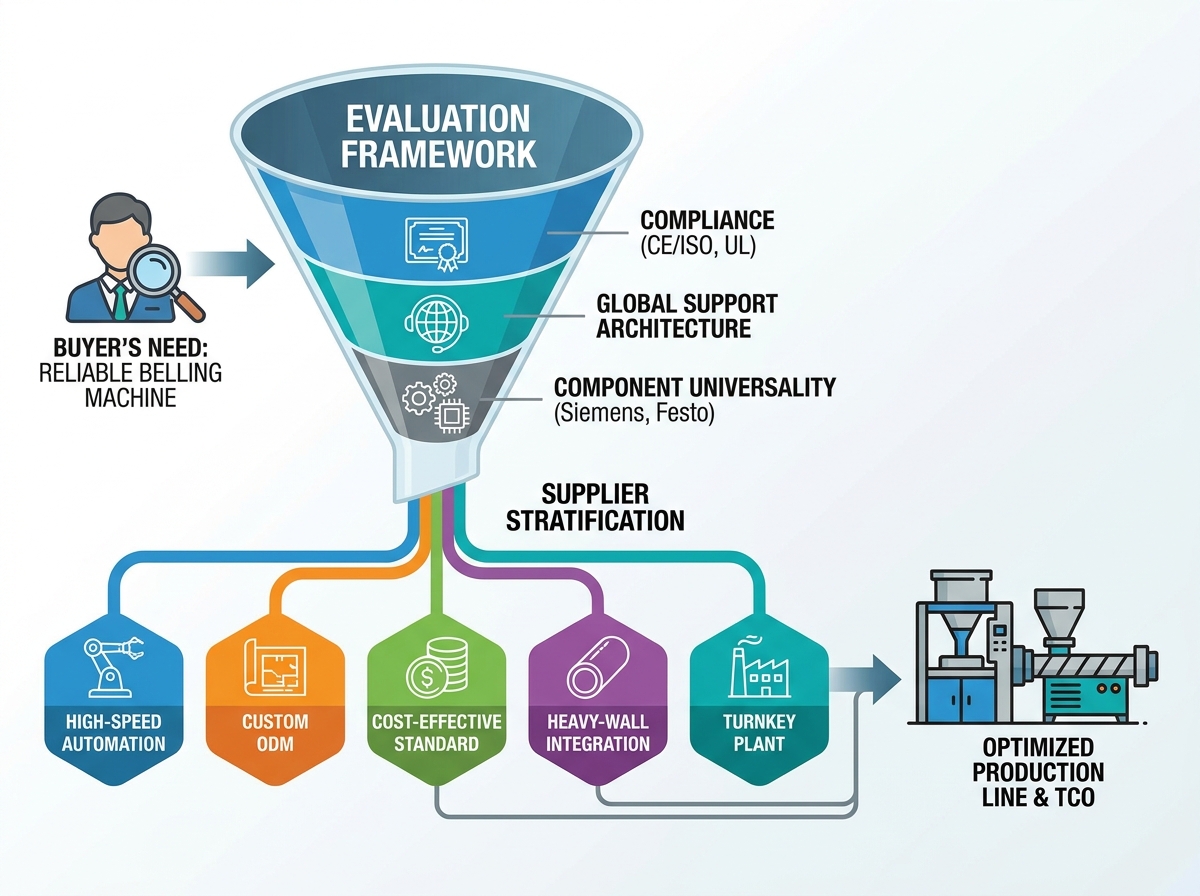
The Evaluation Framework: How to Vet a China Belling Machine Supplier
Defining a successful procurement project requires clear business problem framing. Facility managers often fixate on raw machine speed. However, true success hinges on Overall Equipment Effectiveness (OEE). You want minimal scrap rates during the socketing process. You also need seamless line integration. A poorly integrated unit causes upstream blockages and forces costly manual interventions.
Compliance and certifications form the absolute baseline for any serious evaluation. You should require standard CE and ISO certifications immediately. These documents prove basic manufacturing competence and safety compliance. However, North American buyers must push harder. You must emphasize the critical need for UL or CSA compliance. Exporting uncertified electrical panels to these regions guarantees installation delays and severe regulatory fines.
Global support architecture separates premium manufacturers from standard assemblers. Many vendors claim to offer worldwide support. You must differentiate between suppliers relying on independent third-party contractors versus those operating direct regional hubs. Direct hubs provide faster parts dispatch and guaranteed technician training. Furthermore, robust remote diagnostic capabilities are non-negotiable. Top engineers should troubleshoot your PLC logic remotely before dispatching personnel.
The Supplier Support Architecture Comparison chart below highlights the critical differences between vendor support tiers.
Support Tier
Field Service Model
Diagnostic Capability
Parts Availability
Tier 1 (Premium)
Direct regional service hubs
Real-time remote PLC access
Local warehouse stocking
Tier 2 (Standard)
Certified third-party agencies
Video call troubleshooting
Express air freight from China
Tier 3 (Basic)
Fly-in out-of-country technicians
Email/WeChat correspondence
Standard shipping delays
Best Practice: Always request the direct contact information of the regional service manager before finalizing your purchase order.
Top 5 Plastic Pipe Belling Machine Manufacturers (2024-2025 Shortlist)
We profiled five distinct manufacturing archetypes representing the current market leaders. We focused purely on verified engineering capabilities rather than marketing claims.
Demasun: Best for High-Speed, Fully Automated Systems
This manufacturer specializes heavily in fully automatic belling machine technology. Their engineering teams focus on eliminating operator touchpoints entirely. They integrate automated pipe delivery, precision heating, and robotic offloading into a single continuous sequence. Large-scale municipal piping producers benefit immensely from this design. These facilities demand zero-operator interventions to maintain strict profit margins. High-speed servo motors ensure exact positioning and drastically reduce cycle times.
Liansu Machinery: Best for Custom ODM & Niche Specifications
Some projects demand highly specific tooling profiles. This supplier provides unmatched flexibility in mold design for non-standard pipe profiles. Buyers needing bespoke socketing solutions for unique joint designs should prioritize this vendor. They utilize advanced CNC machining centers to carve custom molds quickly. Their engineering department collaborates directly with your team. They draft precise CAD models to ensure the final socket matches your proprietary sealing rings perfectly.
Xinrong Best: Most Cost-Effective for Standard PVC Production
Lean engineering drives this manufacturer's competitive advantage. They deliver extreme reliability for standard U-type and R-type sockets without unnecessary software bloat. Mid-sized manufacturers looking for fast deployment often choose this standard PVC pipe socketing machine. The equipment uses robust, simplified mechanical movements. This approach minimizes maintenance overhead and reduces operator training time. It provides an excellent balance of rugged durability and upfront affordability.
Jwell Machinery: Top Choice for Heavy-Wall HDPE/PP Integration
Thick-walled polyolefins require massive thermal energy management. This manufacturer builds units featuring exceptional heating and cooling capacities. They engineer specialized ovens to penetrate dense plastic walls evenly. This capability ensures seamless synchronization with a high-throughput HDPE pipe extrusion line. Advanced water-cooling jackets rapidly stabilize the socket shape before ejection. This rapid stabilization prevents shrinkage and guarantees dimensional accuracy across large-diameter gas and water pipes.
Grace Machinery: Premium Pick for Turnkey Plant Installations
Facility upgrades often require end-to-end machinery providers. This vendor supplies and services entire manufacturing plants seamlessly. Buyers upgrading their complete infrastructure strongly prefer a single point of warranty contact. They handle the extruder, downstream cooling, haul-off, cutting, and belling stages. Their internal network connects every machine via a unified control protocol. This holistic approach eliminates integration blind spots and ensures synchronized data reporting across the entire factory floor.
Key Technical Dimensions When Evaluating an Automatic Belling Machine
Heating precision heavily dictates the final quality of a pipe socket. You must evaluate the oven architecture rigorously. Dual-oven or advanced infrared heating systems prevent pipe deformation efficiently. They apply thermal energy evenly across the pipe circumference. Uneven heating causes the plastic to warp during the expansion phase. This warping drastically increases your scrap rates. Infrared systems penetrate the polymer matrix quickly. They reduce overall heating times and protect the pipe surface from scorching.
You should also measure a machine's efficiency by its tooling changeover time. Quick-change systems are absolutely essential for multi-SKU facilities. Old-fashioned bolted molds take hours to swap and align. Modern units utilize pneumatic clamping and pre-heated mold stations. These upgrades allow operators to switch pipe diameters in minutes. Implementing Single-Minute Exchange of Die (SMED) principles keeps your production schedule agile.
Component universality prevents disastrous vendor lock-in scenarios. You must emphasize the importance of internationally available pneumatics and electronics. Insist on brands like Festo or SMC for air cylinders. Demand Siemens, Schneider, or Allen-Bradley for PLC and HMI components. Proprietary circuit boards will ruin your production schedule when they fail. Standardized components allow your local maintenance team to source replacements from nearby distributors instantly.
Common Mistakes:
Accepting proprietary PLC passwords. Always demand full open access to the machine's programming logic.
Ignoring regional voltage fluctuations. Ensure the manufacturer installs robust voltage regulators tailored to your local grid.
Overlooking cooling cycle limits. Faster heating means nothing if the cooling cycle bottlenecks the ejection process.
Implementation Risks: Synchronizing with Your Existing Extrusion Line
The bottleneck risk poses the greatest threat to a successful installation. Mismatched line speeds between the extruder and the belling unit cause catastrophic line pile-ups. Your extruder pushes plastic continuously. If the socketing cycle takes too long, pipes will crash into the delivery table. You must calculate the exact maximum output of your extrusion equipment. Share these exact speeds with your supplier. They must engineer the cooling and ejection cycles to outpace your extruder slightly.
Software handshakes represent a complex reality on the factory floor. You are integrating new PLC logic with legacy systems on your current PVC pipe production line. Older extruders might use basic relay logic or outdated communication protocols. The new socketing unit likely uses modern Profinet or EtherCAT networks. You must bridge this communication gap flawlessly. The equipment must share critical signals like "pipe ready," "line stop," and "emergency halt." Failure to map these signals leads to mechanical collisions and safety hazards.
Space and layout constraints frequently catch buyers off guard. You must address the physical footprint of the new machinery early. Upgraded automation often requires larger safety enclosures and wider access panels. Furthermore, you must consider the necessity of automated pipe delivery tables. These tables buffer the pipes between the cutter and the belling oven. Request a precise 2D CAD layout from the supplier. Overlay this drawing onto your actual floor plan to guarantee adequate forklift access and operator walkways.
Procurement Next Steps: Securing Your Investment
The Factory Acceptance Test (FAT) serves as your primary defense against faulty equipment. You must demand a comprehensive video or in-person FAT before authorizing shipment. The supplier must run your specific pipe samples. They must test your exact material grades and wall thicknesses. Running lightweight test pipes proves nothing. You want to see the machine handle your heaviest, thickest-walled products under continuous operation for several hours.
Structuring payment terms around performance milestones offers vital contractual safeguards. Do not pay the full balance before the machine leaves the factory. Follow a strict milestone approach to maintain leverage:
Down Payment: Release 30% to initiate the engineering and manufacturing phase.
FAT Approval: Release 50% only after a successful and documented Factory Acceptance Test.
SAT Completion: Hold the final 20% until successful commissioning and Site Acceptance Test (SAT) at your facility.
Finally, negotiate a comprehensive spare parts agreement into the initial purchase order. Shipping heavy metal components overseas later takes weeks and costs a fortune. Demand a two-year critical wear-parts package upfront. This package should include extra heating elements, pneumatic seals, standard relays, and specialized sensors. Having these parts on your shelf on day one guarantees maximum uptime during the critical first years of operation.
Conclusion
Selecting the right plastic pipe belling machine requires looking far past the initial quote. You must assess the supplier's true engineering depth and global after-sales infrastructure. Focus heavily on universal components, precise heating technology, and robust software integration capabilities. These factors directly dictate your future production stability.
Narrow your options strategically to two or three suppliers. Base this shortlisting logic on your specific material requirements, such as PVC versus HDPE. Evaluate your internal automation goals and tooling changeover needs. Eliminate vendors who cannot provide transparent FAT frameworks or standardized global components.
Take action today by requesting detailed technical layouts from your shortlisted candidates. Demand itemized brand component lists for all pneumatics and electronics. Furthermore, insist on speaking with reference contacts from similar buyers in your region. These real-world conversations will reveal the true reliability of their machinery and support networks.
FAQ
Q: What is the standard lead time for a custom belling machine from China?
A: Lead times typically range from 45 to 90 days. Standard machines often ship within six weeks. Custom ODM builds or complex multi-oven configurations take longer due to bespoke mold machining and extended software testing phases.
Q: Will a Chinese belling machine sync with my European extruder?
A: Yes, they integrate smoothly provided the supplier uses compatible PLC protocols like Profinet or Modbus. You must provide accurate line speed data and downstream signal requirements during the initial engineering phase to ensure proper software handshakes.
Q: How do manufacturers handle installation and training overseas?
A: Most premium manufacturers dispatch engineers directly for on-site commissioning. The buyer usually covers travel and accommodation costs. Alternatively, many suppliers now provide comprehensive video tutorials and remote Augmented Reality (AR) troubleshooting sessions for self-installation.
Q: Can one machine process both PVC and HDPE pipes?
A: It is technically possible by changing molds and heating parameters. However, it is highly inefficient. PVC and HDPE require vastly different heating curves and cooling times. Dedicated machines are strongly recommended to maintain high production speeds.