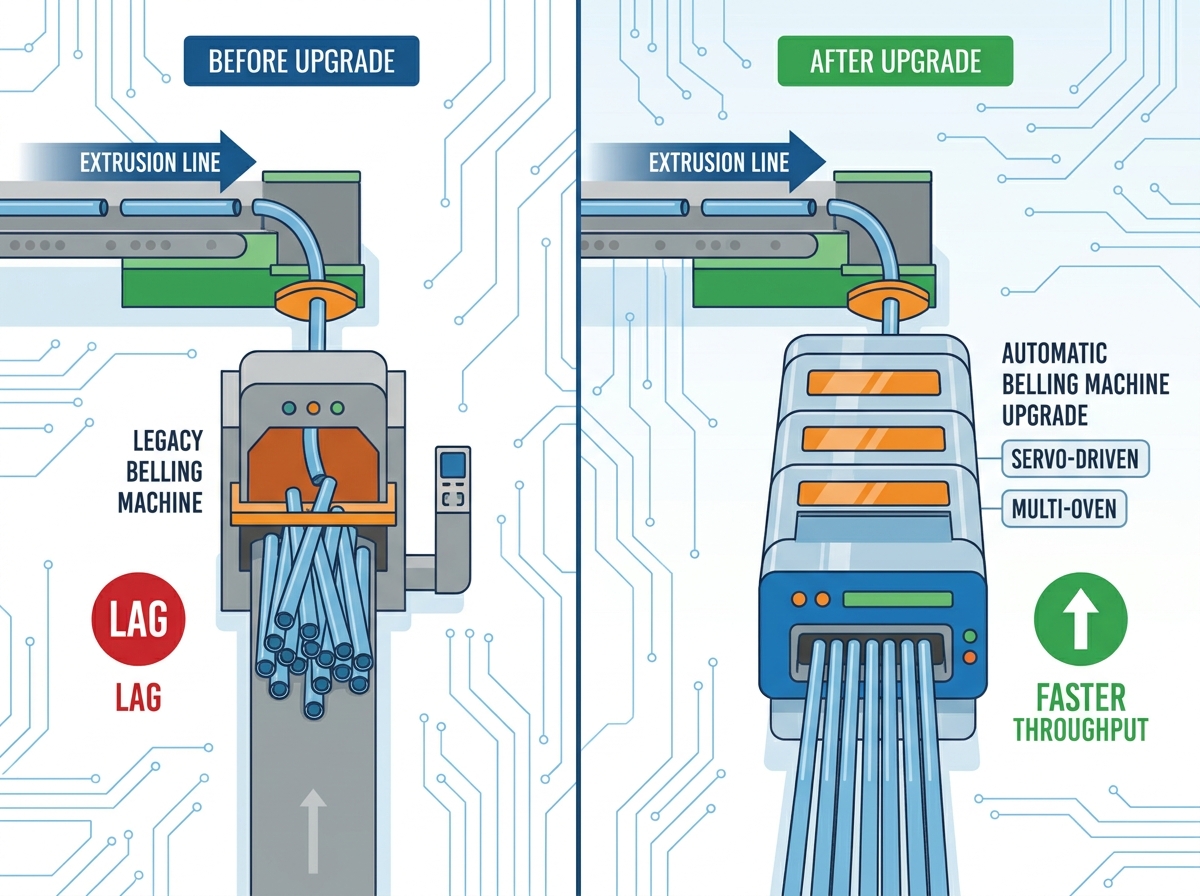
Extrusion speeds have skyrocketed across the plastics manufacturing sector recently. Newer extruders push raw material at record rates. However, the downstream belling process often acts as the primary bottleneck. It severely limits your overall factory throughput. Manufacturers face frustrating delays when socketing cannot keep pace with extrusion. You might think a complete line replacement is necessary to resolve this. Fortunately, upgrading your legacy setup proves much more cost-effective. It elegantly bridges the gap between fast extrusion and final pipe finishing.
This guide gives plant managers and investors a strict evaluation framework. You will discover how to select high-return equipment for your facility. We reveal how to identify the right machinery upgrades to match high-speed outputs. Furthermore, we outline how to find the right global manufacturing partner. Read on to master the strategic upgrades needed to scale your operations safely and profitably.
Key Takeaways
Upgrading to servo-driven, multi-oven belling machines can synchronize downstream processes with high-speed extrusion lines, eliminating cycle-time lag.
Integrating an energy-saving belling machine reduces thermal loss and lowers the Total Cost of Ownership (TCO) over a 3-5 year operational horizon.
Sourcing from the best China belling machine manufacturer (PVC pipe focus) requires strict Factory Acceptance Testing (FAT), verified component sourcing (e.g., Siemens/Schneider PLCs), and transparent after-sales Service Level Agreements (SLAs).
System compatibility is critical: PVC and CPVC require different heating and cooling profiles, demanding adjustable, modular belling stations.
The Business Case for Upgrading Your Plastic Pipe Belling Machine
Outdated equipment creates severe operational headaches on the factory floor. It leads to thermal inconsistency across the pipe socket. You will see higher scrap rates because of defective joints. Operators face forced extruder slowdowns daily. They must throttle production speeds just so the older unit can catch up. This ruins your overall factory efficiency. It also prevents you from maximizing your initial extruder investment.
Upgrading your plastic pipe belling machine resolves these core issues immediately. What does a successful upgrade look like? First, you match extruder line speeds perfectly. If your line runs at 15 meters per minute, the downstream unit must process at that exact rate. Second, you achieve a defect rate below 1% on all socket joints. Precise heating and forming guarantee consistent dimensional accuracy.
Consider the massive opportunity cost of doing nothing. Manual interventions drain factory resources rapidly. Semi-automatic processes require constant operator attention. You incur heavy labor overhead continuously. You also introduce serious safety compliance risks. Operators handle hot plastics and heavy machinery manually. Material waste piles up from improper socket forming. Every defective pipe eats directly into your profit margins. An intelligent upgrade eliminates these hidden costs entirely.
Best Practices and Common Mistakes
Best Practice: Audit your current scrap rate before buying new equipment. You need baseline data to measure future improvements accurately.
Common Mistake: Buying a machine rated exactly for your current speed. Always purchase equipment capable of handling 20% faster speeds. This future-proofs your production line.
Core Technologies Driving Faster Cycle Times
You must demand specific technical upgrades in modern equipment specs. Break these down into four core solution categories. Each category addresses a specific production bottleneck.
Heating Innovations
Legacy machines rely on single-oven setups. You should shift to double or triple-oven infrared heating systems. Multiple ovens provide rapid, uniform softening. They prevent material degradation effectively. The pipe absorbs heat gradually across distinct stages. This eliminates surface burning while ensuring deep core pliability. You get a perfect melt state before forming begins.
Automation and Precision
Prioritize automation and precision control. An advanced automatic belling machine utilizes advanced servo-motor traction. Servo motors deliver exact mechanical positioning. A PLC-controlled hydraulic socketing mechanism ensures exact dimensional accuracy. It pushes the forming mandrel into the heated pipe flawlessly. You get identical sockets every single time. It removes human error completely.
Cooling Efficiency
Mandate superior cooling efficiency. Fast forming means nothing if cooling takes too long. Integrate high-velocity forced-air systems. Better yet, use chilled-water cooling jackets. These systems solidify the socket instantly. They reduce the overall cycle time dramatically. Quick solidification prevents post-forming shrinkage. It locks in the correct dimensions permanently.
Sustainability Upgrades
Focus heavily on sustainability. An energy-saving belling machine features heavily insulated heating chambers. These chambers use thick ceramic fiber materials. They trap heat efficiently inside the oven. They cut kilowatt-hour consumption per pipe significantly. You save money while meeting strict green manufacturing standards.
Review the comparison matrix below to understand the technological shift.
Technology Area
Legacy Equipment Standards
Modern Equipment Upgrades
Heating System
Single-oven convection
Multi-oven infrared tracking
Motion Control
Pneumatic cylinders
Servo-motor traction
Cooling Mechanism
Ambient air exposure
Chilled-water cooling jackets
Thermal Insulation
Basic metal shielding
Ceramic fiber encapsulation
Integration Realities: Synchronizing with Your Existing PVC & CPVC Pipe Extrusion Line
Retrofitting new equipment carries distinct engineering realities. You cannot simply plug in a new unit. Integrating it into an existing PVC pipe production line requires careful planning. Implementation risks include physical footprint constraints. You also face electrical load misalignments. Evaluate your factory floor layout before purchasing.
Upstream synchronization matters most during integration. The socketing station's PLC must communicate seamlessly. It needs to talk directly to the main extruder haul-off unit. It must also sync with the cutting unit. This communication prevents catastrophic pipe jamming. If the cutter sends a pipe early, the socketing station must be ready. Smart sensors track pipe movement across the entire line. They adjust traction speeds dynamically to prevent collisions.
Material variability introduces another complex engineering layer. Processing standard polymers differs greatly from running a CPVC pipe extrusion line. CPVC possesses higher temperature resistance. It exhibits much greater material rigidity. Therefore, the socketing station must feature customizable heating profiles. You need robust clamping forces to grip the rigid CPVC firmly. Standard clamps will slip under pressure. Slippage causes deformed sockets and high scrap rates. A modular setup allows you to switch profiles seamlessly between different materials.
Best Practices and Common Mistakes
Best Practice: Demand open-protocol PLCs like Siemens or Allen-Bradley. They ensure easy integration across different machinery brands in your facility.
Common Mistake: Ignoring floor space requirements. Triple-oven systems require significantly more linear space than legacy single-oven units. Always measure twice.
Criteria for Identifying the Best China Belling Machine Manufacturer (PVC Pipe Systems)
Evaluating overseas suppliers requires a skeptical, evidence-based approach. When shortlisting the best china belling machine manufacturer pvc pipe factories rely on, you must look beyond unit price. Cheap equipment often costs more over time. Use a strict vendor evaluation framework to protect your investment.
Demand component transparency immediately. Ask detailed questions about core parts. Are the pneumatics, servos, and PLCs globally sourced? You need recognized brands like Siemens, Schneider, or SMC. Global sourcing ensures you can buy replacement parts locally. Proprietary components trap you into expensive international shipping for simple fixes.
Verify compliance and testing protocols. Do not accept a manufacturer without ISO 9001 and CE certifications. These prove basic manufacturing competence. Furthermore, require a rigorous Factory Acceptance Test (FAT). Ask for a live video feed of the machine running. They must use your specific pipe dimensions during the test. Do this before making the final shipment payment.
Address the importer's reality upfront. Discuss logistical considerations early in the negotiation. Ask for precise shipping dimensions. Will the machine fit in a standard 40-foot high-cube container? Detail the installation commissioning support. Will they send engineers, or just provide video tutorials? Ensure warranty enforcement terms are clear. Clarify who pays for shipping if a warranty part fails prematurely.
Taking these steps prevents costly surprises. It builds a foundation of trust between you and the manufacturer. Do not skip any phase of this due diligence process.
ROI and Financial Projections
Move away from analyzing just upfront capital expenditure (CapEx). You must focus on long-term financial returns over five years. A comprehensive calculation model reveals the true value of an upgrade. It justifies the initial purchase price to your stakeholders.
Calculate inputs across three distinct financial categories:
Labor Reduction: Transitioning from semi-auto to fully auto systems eliminates dedicated operators. You can reassign these workers to higher-value quality control tasks. This optimizes your payroll spend.
Material Savings: Advanced sensors reduce rejected pipes drastically. You stop throwing away expensive resin because of deformed sockets. Calculate your current scrap weight and multiply it by raw material costs. This is pure recovered profit.
Energy Offset: High-efficiency infrared elements consume less power. Insulated ovens trap heat effectively. Calculate the local kilowatt-hour cost against the promised energy savings. Lower utility bills improve your bottom line directly.
Use a decision matrix to weigh options objectively. You might face a 20% higher upfront equipment cost for a premium model. However, this model might deliver a 15% increase in overall line output. The increased daily production volume quickly amortizes the initial premium. Cheaper machines often throttle the whole extrusion line. Premium units unlock your extruder's maximum potential. Always calculate the profit generated from 15% extra sellable pipes per year. The math consistently favors premium automation.
Conclusion
The downstream finishing process should dictate efficiency, not hinder it. Upgrading your equipment eliminates frustrating production bottlenecks entirely. It harmonizes the overall manufacturing workflow. You unlock the true speed potential of your existing extruders.
Advise your procurement team to prioritize specific machine traits. Focus heavily on machine synchronization first. Prioritize strict energy efficiency next. Always demand reliable OEM support networks. Never base your final purchase decision on rock-bottom pricing alone.
Take action today to optimize your factory floor. Download a standardized specification checklist for your procurement team. Contact a qualified engineering group for a comprehensive line-speed audit. Start producing higher-quality pipes at maximum speeds right now.
FAQ
Q: What is the standard cycle time for an automatic PVC pipe belling machine?
A: Cycle times vary significantly based on pipe diameter and wall thickness. For small pipes under 50mm, advanced machines achieve cycle times between 8 to 15 seconds. For larger pipes approaching 200mm, the process requires deeper heating. This pushes cycle times to 40 or 60 seconds. Multi-oven setups reduce these durations substantially.
Q: Can one belling machine handle both solid-wall and corrugated plastic pipes?
A: No, they generally cannot. Solid-wall pipes require smooth expanding mandrels and external cooling jackets. Corrugated pipes require entirely different gripping mechanisms. They need specialized internal forming tools to preserve the ribbed structure. You must purchase dedicated machines or undergo massive, impractical tooling changeovers.
Q: What is the difference in belling requirements for standard PVC vs. CPVC?
A: CPVC possesses a higher glass transition temperature than standard PVC. It requires significantly higher heating temperatures and longer thermal soaking times. The material is also more rigid. Therefore, your machine needs upgraded hydraulic clamping forces to hold the pipe securely during the mandrel insertion phase.
Q: How do I verify the after-sales support of a Chinese belling machine supplier?
A: Demand a written Service Level Agreement (SLA) before purchasing. Ask if they have local agent networks in your country. Verify their remote troubleshooting capabilities. Ensure their PLC systems support internet-based remote diagnostics. Finally, ask for references from other buyers in your region and contact them directly.