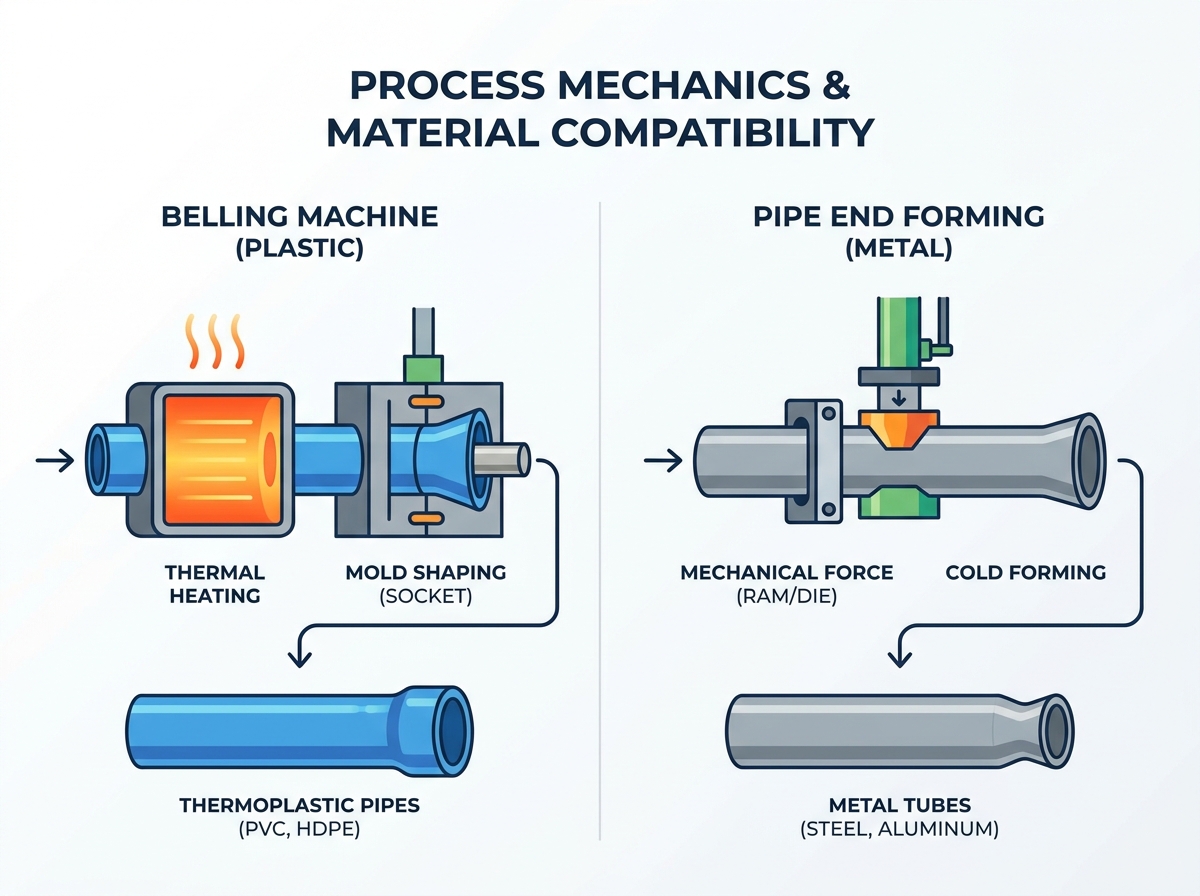
Capital equipment procurement for tube and pipe manufacturing requires absolute precision. You need strict alignment between material science, desired joint geometries, and your daily production throughput. Misaligning machine capabilities with production needs routinely leads to catastrophic joint failure in the field. Facilities also experience unacceptable scrap rates and severe downstream bottlenecks when adopting the wrong shaping methods.
This comprehensive guide breaks down the critical technical distinctions between socketing equipment and general pipe end formers. We will help your production managers and procurement teams shortlist the correct technology efficiently. You will learn exactly how to evaluate vendors and integrate these systems into your floor. By understanding these mechanical differences, you can secure machinery perfectly matched to your application.
Key Takeaways
Application Divide: Belling machines are purpose-built for thermoplastic pipes (PVC, HDPE, CPVC) relying on heat and mold shaping, whereas end forming machines primarily use mechanical cold-forming for metals (and occasionally rigid polymers).
Process Mechanics: Belling creates a socket for interlocking joints (fluid transport); end forming alters the pipe's diameter or shape (flaring, beading, reducing) for mechanical assemblies or automotive/HVAC fluid lines.
Integration: Automatic belling machines are typically synchronized directly downstream of extrusion lines, while end formers often operate in standalone cells or alongside CNC benders.
Vendor Sourcing: Evaluating a belling machine manufacturer vs pipe end forming supplier requires different criteria—focusing on heating uniformity for the former, and hydraulic force/tooling wear for the latter.
Defining the Equipment: Core Functions and Capabilities
Selecting the right machinery begins with understanding fundamental capabilities. Each machine type targets entirely different physical principles and end-use applications.
The Plastic Pipe Belling Machine
The plastic pipe belling machine operates on strict thermal manipulation principles. You will frequently hear the industry refer to it as a PVC pipe socketing machine. Its primary function is applying controlled thermal heating to soften the end of a thermoplastic pipe. Once the plastic reaches a pliable state, the machine uses a mandrel or an external mold. Systems often employ vacuum or pressure assistance to form a bell or socket. Common geometric profiles include U-type, R-type, or rectangular sockets.
You primarily use these machines for creating integral joints. These joints are vital for fluid transport infrastructure. They serve plumbing, drainage, sewage, and electrical conduit systems reliably. The socket allows two identical pipes to interlock flawlessly. This interlocking process eliminates the need for external couplings.
The Pipe End Forming Machine
The pipe end forming machine utilizes immense mechanical force instead of external heat. It leverages hydraulic, pneumatic, or servo-electric power systems. The machine delivers this force via a ram, rotary tools, or segmented dies. These tools permanently alter the shape of a rigid tube or pipe. The machine expands, reduces, flares, beads, or thickens the pipe ends rapidly.
You typically deploy this equipment for mechanical assemblies. Its primary use cases include automotive exhaust systems, aerospace fluid lines, HVAC networks, and structural frames. The formed ends connect to hoses, flanges, or engine blocks. They do not typically interlock with identical pipe lengths like belled plastics do.
Core Equipment Comparison
Feature
Belling Equipment
End Forming Equipment
Primary Material
Thermoplastics (PVC, HDPE, CPVC)
Metals (Steel, Copper, Aluminum)
Forming Principle
Thermal softening and mold shaping
Cold mechanical force and die pressing
Common Outputs
U-type sockets, R-type sockets
Flares, beads, reductions, expansions
End-Use Application
Underground fluid and cable transport
Automotive, aerospace, and structural
Technical & Operational Differences: Process Mechanics
Understanding the internal mechanics helps you anticipate production challenges. The physics driving these two processes dictate your floor layout, operator training, and maintenance schedules.
Material Compatibility & Manipulation
Belling relies heavily on the viscoelastic properties of polymers. You need highly precise temperature control to succeed. Proper heating prevents material degradation. It also stops brittleness from forming in the socket walls. If you operate a plastic pipe belling machine, uniform thermal distribution is mandatory. Operators must monitor the glass transition temperatures of specific polymer blends closely.
End forming relies entirely on the ductility and yield strength of metals. You process carbon steel, stainless steel, copper, and aluminum here. Operators must calculate mechanical wall thinning carefully. They also account for mechanical springback. Springback occurs when metal naturally attempts to return to its original shape after die pressure releases. Engineers must design tooling to over-bend the metal slightly to compensate.
Tooling and Setup Architecture
Belling machines utilize specialized heating ovens to prepare the material. These ovens often feature infrared elements or ceramic heaters. Sizing mandrels then enter the pipe to dictate the final internal dimensions. Rapid cooling stations use chilled water or forced air. This cooling locks the final shape instantly. Tooling changes usually involve swapping out the mandrel and adjusting the oven timers.
End forming systems utilize heavy-duty clamping dies to secure the material. They rely on forming punches and high-torque rotary heads. Your maintenance team must focus on minimizing tool wear constantly. You also have to manage heavy lubrication continually. Metal-on-metal friction generates immense heat and stress. Proper oiling prevents tool catastrophic failure and part galling.
Cycle Times and Throughput
You must contrast the cycle time limitations carefully. Belling throughput is strictly gated by heating and cooling physics. Plastics absorb and release heat slowly. You cannot rush the thermal transfer without burning the polymer exterior. End forming throughput is gated primarily by mechanical stroke speed. Servo-electric rams move incredibly fast. Part-handling automation also dictates the pace here. Metal forming cycles typically finish much faster than plastic heating cycles.
Production Line Integration & Scalability
How you place these machines on your factory floor determines your overall efficiency. Integration strategies differ wildly between plastic extrusion and metal fabrication environments.
Operators position the equipment immediately after the haul-off and planetary cutting stations. It requires highly synchronized PLC controls. These controls match the main extrusion line speed precisely. This strict synchronization prevents costly bottlenecks. If the belling unit slows down, the entire upstream extrusion line must halt. This stoppage creates massive scrap waste.
Integrating End Forming Equipment
Integrating end forming equipment looks quite different. You rarely place it inline with a continuous mill. Instead, you often drop it into a dedicated fabrication cell. It usually operates post-cutting or post-bending. Robotic arms handle the integration very well here. They load cut tubes into the forming dies rapidly.
However, significant scalability risks exist. Misjudging tooling changeover times can ruin your efficiency. High-mix, low-volume production environments suffer the most. If an operator takes two hours to change metal dies, your daily output drops sharply. You must optimize clamping systems for quick tool swaps.
Process Flow Chart Representation
Extrusion Flow
Raw Material Melting
→
Pipe Extrusion
→
Cutting
→
Inline Socketing
Fabrication Flow
Tube Purchasing
→
Batch Cutting
→
CNC Bending
→
Cell End Forming
Evaluating a Belling Machine Manufacturer vs Pipe End Forming Supplier
Heating precision is your absolute highest priority. Look for evidence of uniform heating technology in their portfolios. This ensures ASTM or DIN compliant wall thickness at the socket. Uneven heat creates weak spots. Automation reliability is also critical. Assess the pipe ejection and transfer mechanisms. They must handle heavy, large-diameter pipes without dropping or scratching them.
Best Practice: Request infrared thermal imaging of their heating ovens. You want to see perfectly even heat distribution across the pipe circumference.
Common Mistake: Ignoring the water cooling jacket design. Slow cooling leads to socket shrinkage after the pipe leaves the machine.
Criteria for End Forming Vendors
Force and deflection matter most in metalwork. Evaluate the machine frame's physical rigidity. It must withstand maximum hydraulic or servo load without bending. This guarantees strict dimensional tolerances on every piece. Tooling availability is your next major priority. Assess the manufacturer’s capability to cut custom dies. They must provide custom die geometries quickly. Standard replacement tooling should always remain in stock at their facility.
Best Practice: Ask for a mechanical deflection report under peak tonnage. Solid cast iron or heavy welded steel frames are mandatory.
Common Mistake: Underestimating the clamping force needed. Weak clamps let the tube slip during ram insertion, ruining the part.
Shared Procurement Considerations
Some purchasing rules apply universally. After-sales support defines your long-term success. Check the availability of localized spare parts. Demand remote diagnostic capabilities through modern PLC modules. Establish preventative maintenance schedules early.
Follow these steps during procurement:
Audit the vendor's energy efficiency metrics. Compare the kilowatt-hour usage per formed piece closely.
Review their software interface. Ensure the HMI allows operators to save hundreds of unique part recipes.
Verify factory acceptance testing (FAT) protocols. Ensure they will run your exact materials before shipping the unit.
Cost Analysis and Implementation Risks
You must evaluate initial capital expenditure against ongoing operational expenses carefully. Budgeting only for the machine purchase leads to financial strain later. Break down the hidden production expenses thoroughly before signing a contract.
Initial CapEx and Operating Expenses
Energy consumption differs wildly between the technologies. Heating ovens draw steady, high-amperage power continuously. Insulation quality dictates your monthly electrical bill here. Conversely, hydraulic pumps pull power in sharp spikes during the ram stroke. Servo-electric formers cost more initially but save massive amounts of electricity over time.
Lubrication and coolant disposal add recurring expenses to end forming. You must buy specialized drawing oils. You also pay to dispose of hazardous waste safely. Tooling lifespan also impacts your monthly budget significantly. Metal dies wear out and require costly resurfacing. Mandrels for plastics generally last much longer due to lower friction.
Risk Mitigation in Adoption
Risk mitigation is vital during the adoption phase. You must protect your production quotas.
Belling risks include inconsistent cooling cycles. This leads directly to out-of-round sockets. Out-of-round sockets fail pressure tests in the field. You must require strict scrap rate guarantees. Demand these during the site acceptance testing (SAT) on your factory floor.
End forming risks look completely different. You will encounter galling and metal splitting frequently. Inadequate clamping pressure causes part slippage. Material variations from your steel supplier can also ruin a production run. You must test materials rigorously. Request that the vendor runs at least fifty pieces of your hardest alloy before you approve the shipment.
Conclusion
Your shortlisting logic remains remarkably straightforward. Your decision is largely dictated by your raw material. Plastic requires one specific thermal path. Metal requires an entirely mechanical approach. The target industry standard also guides your hand. Fluid transport piping demands integral belling. Mechanical assembly absolutely requires end forming precision.
For your next steps, define your exact pipe materials clearly. Note your wall thickness ranges on a spreadsheet. Establish your required cycle times per shift. Do all of this before issuing an RFQ to vendors. Request proof-of-concept testing immediately. Ask prospective manufacturers to run your specific raw materials. Observing your own material forming in their factory is the only way to guarantee success.
FAQ
Q: Can an end forming machine be used on plastic pipes?
A: Generally no. While cold forming works on ductile metals, rigid plastics will crack or shatter under high-pressure mechanical rams without precise thermal softening (which requires dedicated belling equipment).
Q: What is the difference between an automatic belling machine and a semi-automatic one?
A: Automatic machines integrate directly into an extrusion line, fetching, heating, belling, and ejecting without human intervention. Semi-automatic requires an operator to manually load cut pipes into the heating and forming stations.
Q: How does belling impact the pressure rating of an HDPE or CPVC pipe?
A: If executed correctly by a quality machine, the socket maintains the required wall thickness and structural integrity to meet standard pressure ratings (e.g., SDR classifications). Inferior heating/cooling causes thinning, creating failure points.