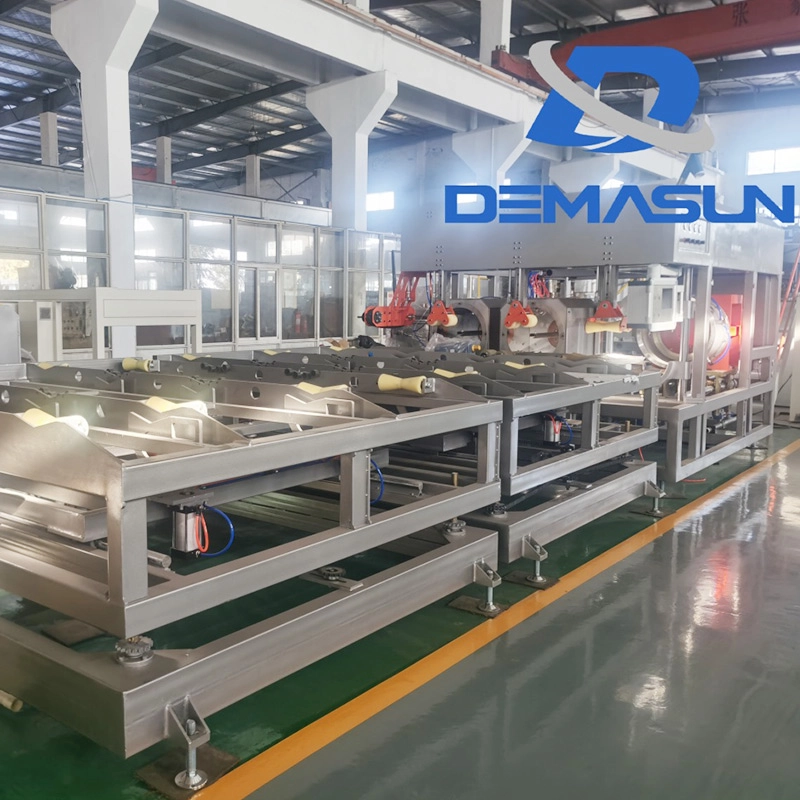
Manufacturing PVC pipes at scale demands equipment that combines speed, precision, and reliability. An automatic PVC pipe socketing machine delivers all three. These PLC control systems automate the entire belling process, from raw pipe input to finished socket output. If you need fast production, automation becomes essential for maintaining quality and controlling labor costs.
The Automatic Belling Process Explained
Modern automatic socketing machines divide the production cycle into precisely controlled stages. Understanding each phase reveals why these machines outperform manual and semi-automatic alternatives.
Step 1: Automatic Pipe Loading
Pipes enter the machine through an automated feeding system. Sensors verify pipe positioning and diameter before the cycle begins. The CNC controller references a database of pipe specifications to set optimal parameters for that specific product. This eliminates manual setup errors and ensures every pipe receives identical treatment.
Step 2: Infrared Heating
Infrared heating elements warm the pipe end uniformly. Unlike traditional resistance heating, infrared technology penetrates the material evenly, preventing surface scorching while achieving proper depth heating. The automatic PVC pipe socketing equipment monitors temperature in real-time, adjusting power delivery to maintain consistent heat input regardless of ambient conditions.
This energy-efficient approach reduces power consumption by 35-40% compared to conventional heating methods. Over a production year, the energy savings substantially offset the initial investment premium.
Step 3: Socket Forming
Once the pipe reaches optimal temperature, pipe will be moved to the belling mould in position. The die expands the heated pipe end into the specified socket profile—R-Type, U-Type, or Square. Precision guide rails ensure the socket forms concentric with the pipe axis, meeting the tight tolerances required by international standards.
Step 4: Cooling and Unloading
Air coolind or water spray systems rapidly solidify the socket geometry. The automatic machine then ejects the finished pipe onto a collection conveyor or stacking system. The entire cycle completes in 8-20 seconds depending on pipe size.
Key Advantages of Automation
Consistent Quality: Every socket meets identical specifications regardless of operator skill variations.
Lower Labor Costs: One operator manages multiple machines simultaneously.
Reduced Waste: Precision controls minimize overheating and forming errors.
Traceability: Digital records support quality certification requirements.
Production Capacity Considerations
When evaluating automatic socketing machines, match the equipment capacity to your production goals. Machines typically specify a diameter range and maximum hourly output. Consider not just your current needs but projected growth—modular designs allow capacity expansion without complete equipment replacement.
The return on investment calculation should include labor savings, material waste reduction, and quality improvement benefits. Most manufacturers recover the automation premium within 12-24 months depending on production volume and local labor costs.
Maintenance for Maximum Uptime
Automatic machines require regular maintenance to sustain performance. Daily checks include heating element inspection and cleaning, die alignment verification, and conveyor belt tension adjustment. Monthly maintenance covers hydraulic fluid analysis, electrical connection tightening, and sensor calibration.
Preventive maintenance schedules reduce unexpected downtime. Demasun's technical support team provides comprehensive training and documentation to keep your equipment operating at peak efficiency.
FAQ
Q: How does infrared heating improve socket quality?
A: Infrared heating provides uniform temperature distribution across the pipe wall, eliminating hot spots that cause material degradation. This results in consistent socket dimensions and superior surface finish.
Q: Can automatic machines handle multiple socket types?
A: Yes. Quick-change die systems allow switching in different pipe size for socketing within 20-30 minutes. The PLC system stores parameters for each configuration.
Q: What power supply do these machines require?
A: Most industrial automatic socketing machines operate on 380V three-phase power at 50-60Hz. Verify local specifications before ordering.
Q: How long does it take to train operators?
A: Basic operation training requires 4-8 hours. Comprehensive maintenance training typically spans 2-3 days. Demasun includes training with every machine purchase.
Conclusion
An automatic PVC pipe socketing machine transforms high-volume pipe manufacturing operations. The combination of CNC control, infrared heating, and automated material handling delivers the consistency and throughput that competitive markets demand. When labor costs rise and quality requirements tighten, automation stops being optional and becomes essential for maintaining profitability.